
Web design for dentists
Most people looking for a dental practice bring a history with them: a treatment that hurt, or a bill nobody expected. Whether they call comes down to what your website says about the first appointment, about costs and about dealing with fear.
01
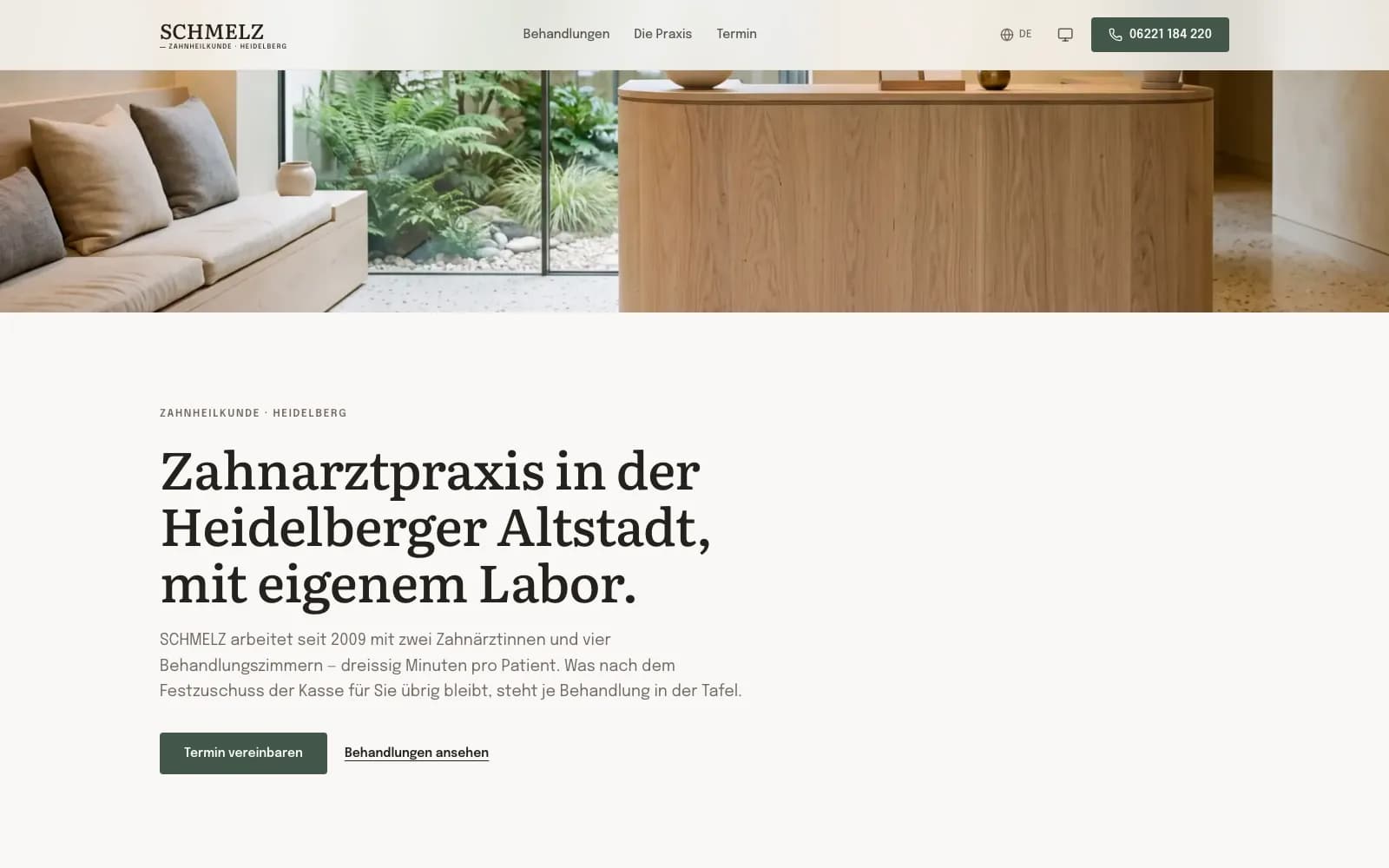
Zahnärzte am Rathsberg shows a practice talking about the first appointment instead of about itself.
The template names every treatment area twice - the clinical term from the treatment plan and the everyday word beside it - walks through the first forty-five minutes step by step, and lists the equipment with the year it arrived, along with what is not in the building.
Fictional brand, built template
Zahnärzte am Rathsberg is an invented practice, not a client engagement. The template is fully built - what it becomes for your practice grows out of your focus areas, your team and your hours.
See it live: Zahnärzte am Rathsberg02
What we have built is live.
These addresses are open. You can visit them and compare before you talk to us.
03
What stops the call is rarely a clinical question.
People who put off the appointment rarely doubt the treatment. They doubt what is waiting for them in the chair.
A practice website carries further when it describes how the first appointment runs, translates the clinical terms into everyday language and explains how the figure in the treatment plan comes about. Those are three things your front desk already says on the phone every day.
04
What someone wants to know before picking up the phone.
Do you take new patients, how soon can I come in, and what happens the first time - the call is decided on those three.
Name every treatment twice
The clinical term as it will appear on the treatment plan, and next to it the same thing in everyday language. Someone searching for a root canal will not find "endodontics".
Describe the first appointment
How long it takes, what gets examined, when an X-ray is taken and what you leave with. A described sequence does more for an anxious patient than any reassurance.
Emergency hours near the top
Someone in pain today is looking for a time and a phone number. Both belong in the first screen, where a phone can dial them with one tap.
05
The pages a dental practice runs on.
Five areas a dental practice needs online.
01
Treatments
One page per area: what happens, how long it takes and where the treatment reaches its limit.
02
Who treats you
Year of licensing, area of focus and continuing education per person - in the terms professional law provides for.
03
Practice and equipment
Rooms, access and equipment with the year it arrived. A device says something once you name which one it is and how long it has been there.
04
What insurance covers
Fixed subsidy, patient share and treatment plan explained - the question most patients arrive with.
05
Appointments and emergency hours
Opening hours, emergency slot and the routes to an appointment, with a word on why symptoms are better handled on the phone than by email.
06
What a patient checks before calling.
Trust comes from details someone can look up and recognise again at the appointment.
Qualifications with a year
Licensing, doctorate, curricula and chamber training, each with its year. The area of focus is the term professional law provides for, and it carries further than a title.
The rest of the team too
Dental hygienist, prophylaxis assistant, front desk: that is where a patient spends most of the time in the chair.
Equipment with the year it arrived
"Surgical microscope since 2017" is something a patient can ask about. Alongside it belongs the list of what the practice does not have in house, and where it refers instead.
Access in numbers
Door width, steps, toilet, parking. Anyone who depends on it needs the measurement, and will otherwise call to ask.

07
People search for a treatment, a way to get there - or a practice that can handle fear.
The site answers those three routes with content your practice has approved. The diagnosis stays with the appointment.
- A specific treatment, usually together with the question of cost and duration
- A practice that takes dental anxiety seriously and writes down how it handles it
- A practice within reach with an appointment soon, often today
08
From inquiry to launch.
After the order and a complete brief, your website is usually ready within a few days - built, hosted and online. The binding date is in your quote, because it depends on the scope. Changes after that are normally done within three working days.
01
Inquiry & quote
You describe your plans and get a binding fixed-price quote.
02
Draft & build
We develop the design and the SEO strategy and build your site from scratch.
03
Go-live
Your site is finished and goes online. You connect your domain with a DNS record - usually done in under five minutes.
04
Ongoing care
Depending on your plan we keep developing the site, install security updates and change or add content on request.
09
What a website for Dentists costs.
That puts us above what you will read elsewhere while comparing. The difference is in the scope: structure and design are made for your company rather than taken from a template, copy and images we take from you or create ourselves, and the site is built so that Google and AI search can read and quote it. Work outside the packages is billed at €120 per hour, announced and approved before it starts.
What a website costs
The company website starts at €6,900 plus VAT, the website system with its own editing area at €14,900. After launch the site stays with us: €49 a month for hosting, updates, backups and monitoring - or €499 a month for full care, which includes ongoing changes, active SEO work and new content.
You get the binding fixed price for your project after a short call, usually within one working day.
10