
Web design for real estate agents
An owner is not looking for an agent, they are looking for someone to entrust their house to. The website decides whether they call - long before anyone talks about commission.
01
Reichert Immobilien shows how a small portfolio reads as more expensive than a full one.
The template carries seven properties with a page each, and alongside them four pages for sale, letting, valuation and management. The owner finds their route without having to go through the property list.
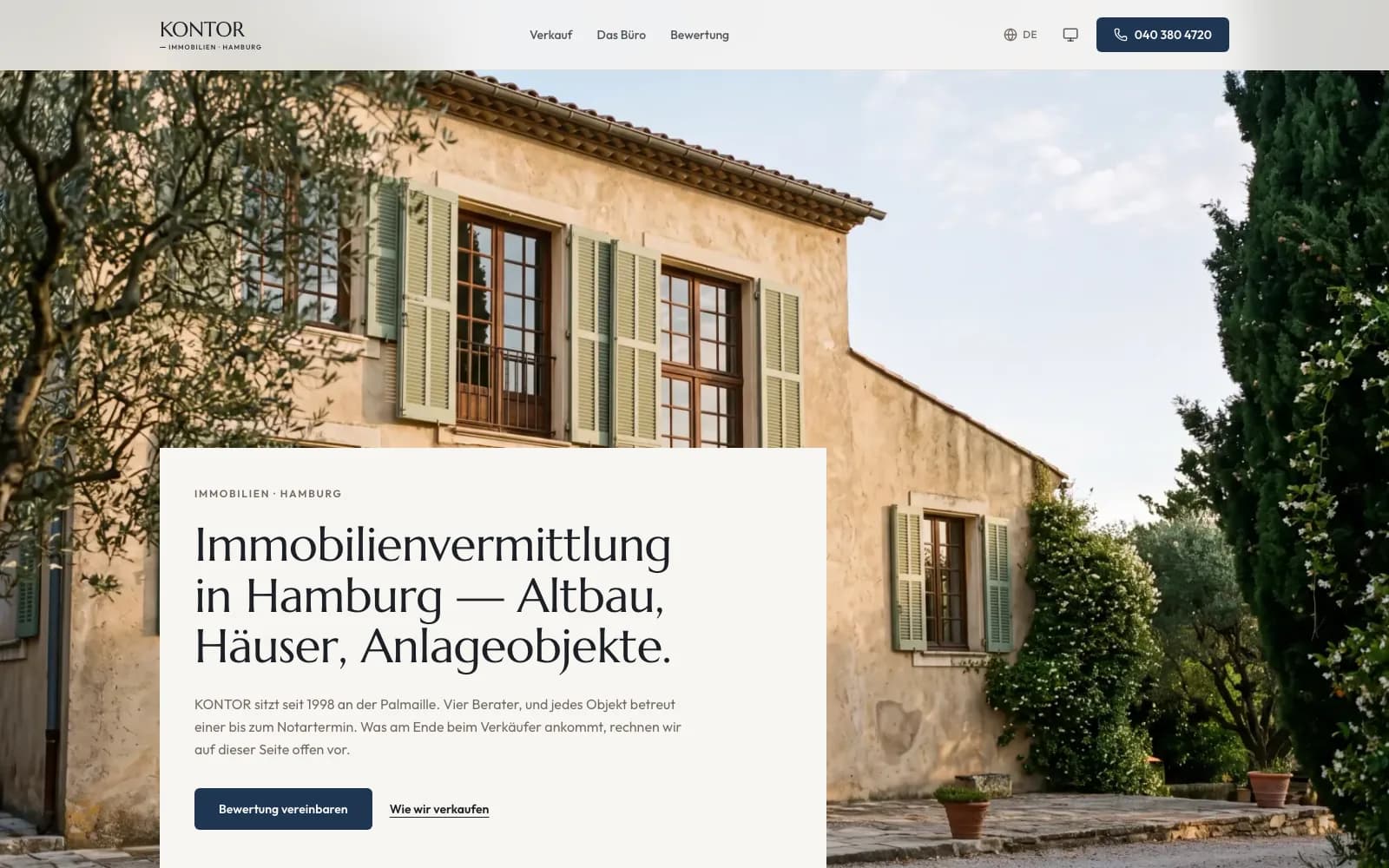
Fictional brand, built template
Reichert Immobilien is an invented brand and not a client mandate. The template is fully built - what it becomes for your agency comes out of your portfolio and your area.
View live: Reichert Immobilien02
What we have built is live.
These addresses are open. You can visit them and compare before you talk to us.
03
Two visitors, one site - and usually the buyer wins.
Most agency sites are property lists. The owner who wants to sell finds nothing meant for them.
Yet they are the more valuable visitor: properties come and go, mandates carry the business. A site that keeps both routes cleanly apart loses neither of them.
04
Win the mandate without losing the buyer.
The site has to lead two routes cleanly - and in a small portfolio carry every single property.
Separate the two concerns
Selling, letting, valuing, managing: each concern gets its own page instead of disappearing into a list of services.
Show every property in full
Location, floor area, year built, energy and condition are stated the same way on every property. A small portfolio tolerates no gaps - there, every one of them shows immediately.
Valuation as the entry point
An owner's first step is rarely the mandate, it is the question of value. That is exactly where the site starts.
05
Two routes that do not get in each other's way.
Five areas where buyers and owners stay out of each other’s way.
01
Properties
The portfolio as a list. With a small, high-value portfolio, a list that gives each property room reads as more expensive than a grid with a filter bar above it.
02
Property page
One page per property: images, full data, location and the direct route to a viewing.
03
What you need
Sale, letting, valuation, management - one page each, because each opens a different conversation.
04
Valuation
How the value is arrived at, what is needed for it and what happens afterwards. An owner's most common entry point.
05
Contact
Contacts with a face and a remit. On a mandate this size, nobody talks to a company.
06
An owner checks you before your offering.
Credibility comes from information that can be followed.
Local knowledge
Streets, locations and price development - evidenced, not claimed. This is the argument no portal has.
A valuation that can be followed
Which methods are applied and where the comparison data comes from.
Discretion
How properties are handled that are not to be offered publicly.
Completed mandates
What was sold, in which location and over which period - anonymised where it has to be.

07
An owner searches differently from a buyer.
Buyers search by property type and location, owners by value and process. Both routes rarely start with the word real estate agent.
- A property type in a location, often with floor area or number of rooms
- A district or a municipality, usually together with the price level
- The process itself: what a sale costs, how long it takes, what has to be done beforehand
08
From inquiry to launch.
After the order and a complete brief, your website is usually ready within a few days - built, hosted and online. The binding date is in your quote, because it depends on the scope. Changes after that are normally done within three working days.
01
Inquiry & quote
You describe your plans and get a binding fixed-price quote.
02
Draft & build
We develop the design and the SEO strategy and build your site from scratch.
03
Go-live
Your site is finished and goes online. You connect your domain with a DNS record - usually done in under five minutes.
04
Ongoing care
Depending on your plan we keep developing the site, install security updates and change or add content on request.
09
What a website for Real estate agents costs.
That puts us above what you will read elsewhere while comparing. The difference is in the scope: structure and design are made for your company rather than taken from a template, copy and images we take from you or create ourselves, and the site is built so that Google and AI search can read and quote it. Work outside the packages is billed at €120 per hour, announced and approved before it starts.
What a website costs
The company website starts at €6,900 plus VAT, the website system with its own editing area at €14,900. After launch the site stays with us: €49 a month for hosting, updates, backups and monitoring - or €499 a month for full care, which includes ongoing changes, active SEO work and new content.
You get the binding fixed price for your project after a short call, usually within one working day.
10